The pioneer in an unlikely World Cup team
 The pioneer in an unlikely World Cup team
 The pioneer in an unlikely World Cup team
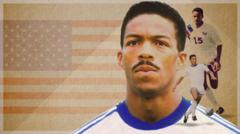
Sport InsightThe pioneer in an unlikely World Cup teamPublished2 hours agoImage source, Getty ImagesByRhia ChohanBBC Sport senior journalistWhen Desmond Armstrong faced the media at the 1990 World Cup in Italy, the opening question he was asked wasn't about the remarkable feat of the USA team reaching the tournament for the first time in four…
تفاصيل الخبر
Sport InsightThe pioneer in an unlikely World Cup teamPublished2 hours agoImage source, Getty ImagesByRhia ChohanBBC Sport senior journalistWhen Desmond Armstrong faced the media at the 1990 World Cup in Italy, the opening question he was asked wasn't about the remarkable feat of the USA team reaching the tournament for the first time in four decades."Why aren't you playing basketball?" was directed at Armstrong, then a 25-year-old defender, who was about to become the first US-born black player to represent the United States at a World Cup."There were no congratulations, or 'how excited are you to be here?'" Armstrong tells BBC Sport."The stereotype was 'you're an American and you're black, so you should be playing basketball'.
Beyond the fact that Americans shouldn't be here in the first place, why are you here?"Days later, he would keep the prolific Italy striker Gianluca Vialli off the scoresheet in a brilliant man-marking display against the hosts at the Stadio Olimpico – a performance that marked a huge turning point for football in the United States and for Armstrong himself.The ripples from that match in Rome are still being felt today.Image source, Desmond ArmstrongImage caption, Desmond Armstrong played several sports as a child before settling on footballFootball came to Armstrong, via a television set, in suburbia.His family moved from the Southeast part of Washington DC when Armstrong was young and later settled in a largely white neighbourhood in Maryland, where he befriended a soccer coach's son.
One afternoon, the coach called Armstrong over to the television.He was pointing to a Brazilian in a New York Cosmos jersey."It was Pele," says Armstrong."His movement reminded me of a lot of the point guards that played basketball, but he was doing it with a ball at his feet."He was one of the few black players on the team, so that connected me."While Pele was popularising a game he'd learned barefoot on the streets of Brazil, much of the American grassroots version was being built on privilege.Unlike the developing youth academies of Europe and South America, where clubs like Ajax and Barcelona were putting money into young talent, development in the US has long run on a pay-to-play model.Families must meet significant costs or seek sponsorship to give their children a shot at advancing – creating a system that has seldom favoured those from less affluent households."It's kind of antithetical to what this game's all about," says Frank Dell'Apa, who has spent 40 years as the Boston Globe's football columnist, covering the game since the days of the original North American Soccer League (NASL)."This is the simplest game with the easiest access.
متابعة الأحداث الرياضية
تأتي هذه التطورات ضمن متابعة مستمرة لأخبار كرة القدم والبطولات، مع اهتمام واضح من الجماهير بمعرفة آخر المستجدات والنتائج والمواعيد.
ما القادم؟
سيتم تحديث التفاصيل فور ظهور معلومات جديدة من المصادر الرياضية، مع متابعة كل ما يتعلق بالمباريات والفرق واللاعبين.